Why Spent Fluorescent Tubes Don't Belong in the Dumpster
A short look at why old lamps get their own pickup, and the simple way to box them so they leave your building in one piece.
October 20, 2026 · 4 min read
The last fixture in the hallway is done. The new lamps are glowing overhead, and the old ones are leaning against the wall in a loose stack. The dumpster is right there at the end of the loading dock. Carrying them over and tossing them in would take two minutes. It's also the move that causes the most trouble down the line, so it's worth knowing why lamps get handled differently before the next change-out day arrives.
What's inside a spent lamp
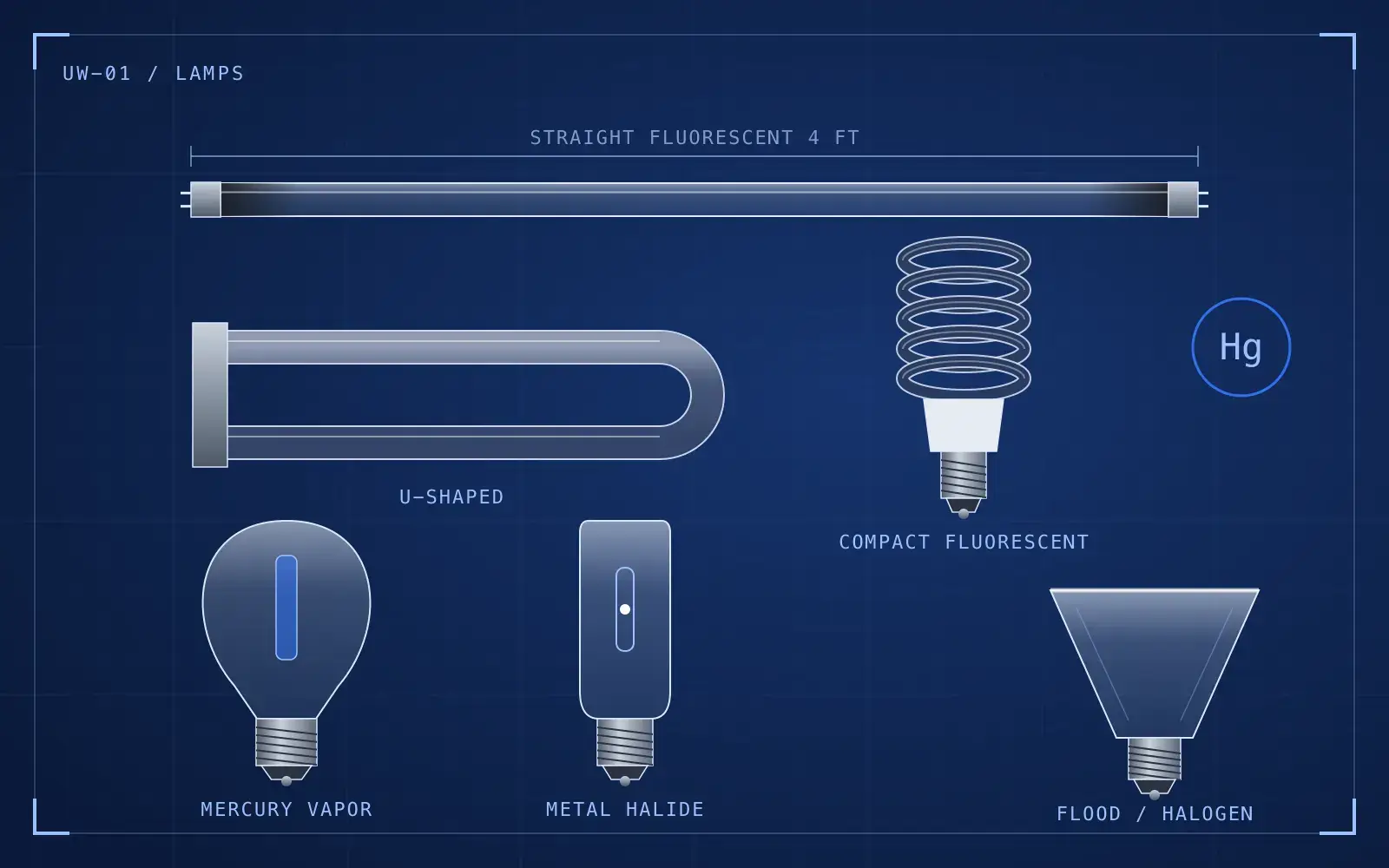
All fluorescent and HID lamps contain a small amount of mercury. That covers straight tubes, U-shaped tubes, compact fluorescents, mercury vapor lamps, metal halide lamps and the other high-intensity types. The amount in any single lamp is small. The problem shows up when a lamp breaks, and a dumpster is about the roughest place a glass tube can end up. Other trash lands on it. A compactor crushes it. A hauling truck jostles it. Once the glass is open, the mercury is loose in the air and the waste around it, and nobody downstream signed up to deal with that.
That's the whole reason lamps travel on their own track. They're kept as whole as possible, packed in boxes, and sent to a recycler that's set up to handle them. Exactly which rules apply to your building, your lamp count and how long you can keep lamps on site is a question for TCEQ, so check with them or ask us. We'd rather you hear it from the source than from a guess in a blog post.
Intact, pre-crushed or already broken
You don't have to sort lamps by shape before you call. Our facility accepts intact and pre-crushed lamps of all types and sizes, including straight tubes, U-shaped tubes, compact fluorescents, mercury vapor, metal halide, arc lamps, flood lamps, incandescent and halogen bulbs. If you have a mix from three different buildings, that's fine. Tell us roughly what you've got and we'll plan the pickup around it.
Intact is the best case, because whole lamps hold their contents until they reach the recycler. If a few broke during the change-out, keep the pieces together. Put them in a sturdy container with a lid, or in a sealed heavy bag set inside a box, and say so when you schedule. Please don't sweep broken glass into the regular trash just to be rid of it. For anything bigger than a stray tube or two, questions about cleanup belong with TCEQ or your own safety contact.
How to box and stage lamps for pickup
Good staging is mostly common sense, and it makes the pickup quicker for everyone. The best box for a straight tube is the one the new tubes came in. It's already the right length, it has dividers or a snug fit, and it's strong enough for the job. Keep it closed with tape once it's full, and write what's inside on the outside so nobody mistakes it for something else.
- Lay tubes flat and parallel in the box, with no loose gaps for them to rattle around in.
- Keep each type together: straight tubes in one box, U-shaped in another, compact fluorescents and HID bulbs in their own.
- Tape the box shut and label it clearly as spent lamps.
- Stack boxes low and keep them stable. A tall tower of lamp boxes is a tipping hazard.
- Store them indoors or under cover where they stay dry, away from heat and away from the path a cart or forklift takes.
Pick one spot and use it every time. When the same corner of the storage room is always the lamp corner, maintenance staff stop leaving tubes in closets, on mechanical room floors and behind the loading dock door. Counting the boxes before you call also helps, since it lets us bring the right containers and plan the stop.
Getting them picked up
We run our own vehicles, and in most cases we collect within 48 hours of your call. If a change-out wrapped up sooner than you planned and the storage room is already full, ask about same day pick up. Buildings that change lamps all year can set up a weekly, monthly or daily on-site collection schedule so tubes never pile up in the first place.
Electrical and lighting contractors can use the same approach at the end of a job: box the tubes, stage them in one spot and call. Property managers can hand the process to their maintenance team as a short checklist. Either way, the aim is the same, which is old lamps leaving in the box they sat in, with nothing broken on the way out. To arrange a pickup or ask about a particular lamp type, call U-Waste Recycling Solutions at 713-360-7310 between 8:00 AM and 4:00 PM, Monday through Friday.
U-Waste Recycling Solutions, 713-360-7310
Call 713-360-7310More articles
How to Store Spent Batteries Between Pickups
A few sorting habits and a sturdy container keep a growing pile of dead batteries from turning into a problem.
Planning Collection for Lamps and Ballasts in a Lighting Retrofit
Old fixtures give up two very different kinds of material on the same day, and each needs its own plan.