Planning Collection for Lamps and Ballasts in a Lighting Retrofit
Old fixtures give up two very different kinds of material on the same day, and each needs its own plan.
October 20, 2026 · 4 min read
On the first day of an LED retrofit, the lamps come out fast. A crew with a lift can clear a warehouse aisle of tubes before lunch. Then the ballasts come out of the fixtures, and the pile on the floor changes. Now there are long boxes of lamps on one side and a bin of heavy metal ballasts on the other, and the schedule says the space has to be handed back on time. The contractors and facility managers who plan for both streams before day one are the ones who finish clean.
A retrofit leaves two things behind
The lamps are the obvious part. Fluorescent and HID lamps contain a small amount of mercury, so they're collected separately from regular trash, boxed whole where possible, and sent on to a recycler. Our facility accepts intact and pre-crushed lamps of all types and sizes, so a retrofit that pulls out straight tubes, U-shaped tubes and a few compact fluorescents from the same building is no trouble.
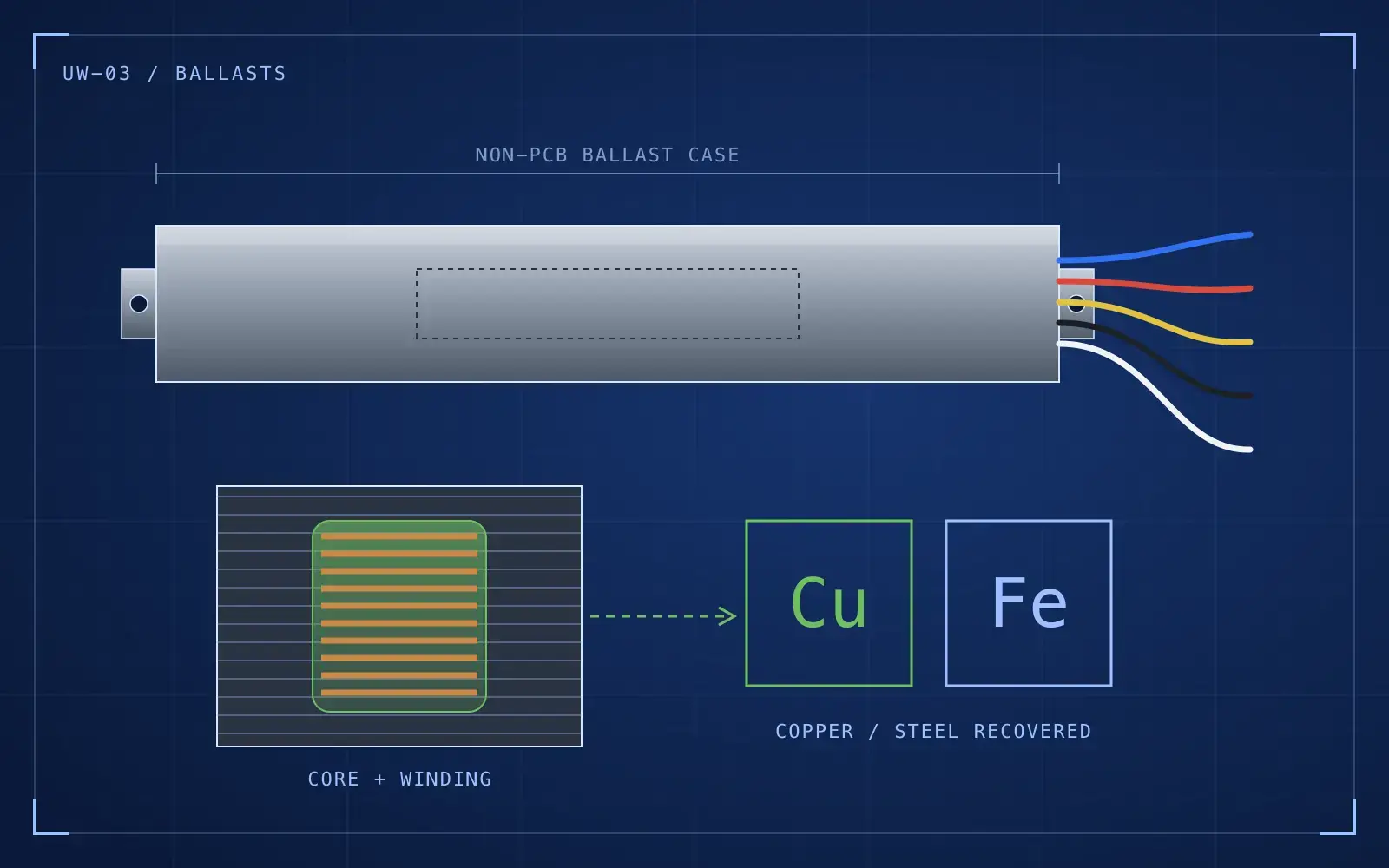
The ballasts are the part people forget. Every fluorescent fixture has one tucked behind the cover, and when the fixture is converted or replaced, the ballast comes out with it. We collect non-PCB ballasts. Check the label on each one. If it doesn't clearly say it's PCB-free, set it aside and call us before it goes into the pile. Don't guess, and don't mix it in with the ones you know are fine.
What happens to a ballast
A ballast is a small, heavy box with a metal case, a steel core and copper windings. When we collect non-PCB ballasts, the copper and steel inside are recovered and reused instead of being buried. That's the practical upside: metal that took real effort to make goes back into use. It's also a way to reduce your liability as the generator, since the ballasts end up at the right place instead of sitting in a back room or riding off in a dumpster.
Ballasts are heavy for their size, and that affects how you handle them. A cardboard lamp box is the wrong container. Use sturdy bins or set them on a pallet, don't overfill anything you'll have to lift by hand, and keep ballasts and lamps in separate spots. A loose ballast dropped onto a box of tubes is a quick way to turn intact lamps into broken ones.
Plan the collection before the first fixture opens
Retrofit work moves quickly, and a staging area that was big enough on Monday can be buried by Wednesday. A short plan made in advance keeps both materials under control. It also gives you something to hand to the crew, so the question of where things go gets answered once instead of fifty times.
- Walk the space and estimate how many fixtures and how many lamps per fixture, so you know roughly how many boxes and bins to expect.
- Pick a staging spot with a hard floor, close to the loading area and out of the way of the crew's lifts.
- Set up separate containers for lamps and ballasts from the start.
- Decide who owns the staging area, so one person counts and labels what comes out each day.
- Call for pickup before the space is full, not after.
Timing depends on the size of the job. For a single-day change-out, one pickup at the end may be all you need. For a phased retrofit that runs across weeks, an on-site schedule keeps the staging area from filling up, and we can set up weekly, monthly or daily collection to match how fast the fixtures are coming down. In most cases we collect within 48 hours with our own vehicles, and same day pick up is available when a job runs ahead of plan.
Settle who owns the old material early
Contractors and building owners sometimes aren't sure who is responsible for the old lamps and ballasts, the crew that removes them or the owner of the building. That depends on your contract and your situation, so settle it in writing before the work starts, and check with TCEQ or ask us if you want a second opinion. What we can say from experience handling this material is that it goes more smoothly when the plan is written down before the first lamp comes down.
Property managers can use the same plan for any building where lighting gets upgraded in stages. Electrical and lighting contractors can build it into their bids as a standard step. To talk through a retrofit and the collection that goes with it, call U-Waste Recycling Solutions at 713-360-7310, Monday through Friday between 8:00 AM and 4:00 PM.
U-Waste Recycling Solutions, 713-360-7310
Call 713-360-7310More articles
Why Spent Fluorescent Tubes Don't Belong in the Dumpster
A short look at why old lamps get their own pickup, and the simple way to box them so they leave your building in one piece.
How to Store Spent Batteries Between Pickups
A few sorting habits and a sturdy container keep a growing pile of dead batteries from turning into a problem.