Daily, Weekly or Monthly: Choosing an On-Site Collection Schedule
The right pickup rhythm depends on how quickly material builds up, how much room you have to hold it, and how much of it you'd rather not see.
October 20, 2026 · 3 min read
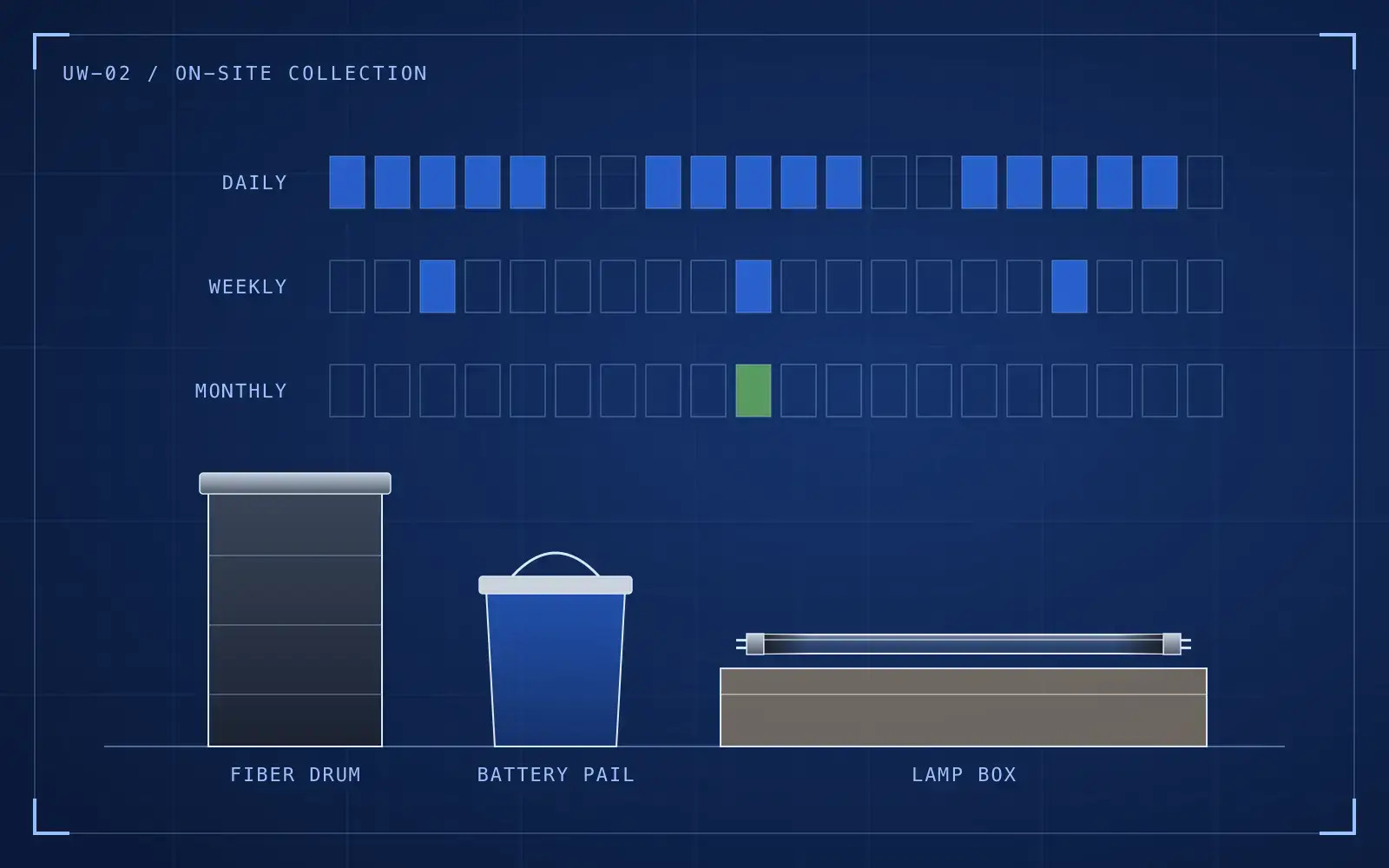
There's a point in every building's life with universal waste when the storage room stops feeling like a storage room. The lamp boxes reach the second shelf. The battery pail needs two hands. Someone has started stacking things in the hallway outside, and everyone agrees it's temporary. That's usually the moment people start asking how often a pickup should happen, and the honest answer is that it depends on three things you can measure.
Three things that set the schedule
The first is pace. How quickly does material show up? A school that changes lamps over summer break has a very different pattern from a maintenance shop that swaps out a few tubes and a few batteries every week. A site with an active retrofit, a repair operation or a steady stream of electronics will build up faster than an office that changes lamps now and then.
The second is space. How much room do you have to hold material safely? Lamps need dry floor space and low stacking. Batteries need sturdy containers on a hard surface. Ballasts are heavy and need bins or a pallet. If your storage area is tight, a pickup frequency that looks wasteful on paper may be the simplest way to keep the area usable and the staff safe. If you have a generous back room, you can let things build longer.
The third is how long your site is allowed to hold material. That depends on the kind of operation you run, and the rules are set by the state, so check with TCEQ or ask us before you decide that a long gap between pickups is fine.
How the three schedules tend to fit
We offer weekly, monthly or daily on-site collection. None of them is better in itself. Each one suits a different pattern, and you can change it as your volume changes.
- Daily suits high-volume sites where material is coming out of service constantly, such as a large facility with a retrofit under way or a busy operation with steady electronics, lamps and batteries.
- Weekly suits mid-size sites that generate a steady, moderate amount and don't have much room to hold it, such as a campus maintenance shop or a property manager with several buildings.
- Monthly suits smaller offices and buildings that change a few lamps and batteries at a time and have a storage spot that can hold a month of material comfortably.
If you're torn between two, start with the more frequent one and adjust. It's easier to stretch a schedule after you've seen how little accumulates than to recover from one that was too thin. Count your containers at each visit for the first couple of months. If they're barely a third full, move to the next longer interval. If they're overflowing before the truck arrives, go the other way.
Where same-day pickup fits
A schedule covers the steady flow. It doesn't cover the one-off. Sometimes a storeroom needs emptying before an inspection, a renovation wraps up early, a tenant moves out and leaves a pile, or someone finally cleans out the closet at the end of the hall. For those, we offer same day pick up, and in most cases our own vehicles collect within 48 hours when you don't need it that fast.
Many sites use both. A monthly schedule handles the routine, and a same-day call handles the surprise. That combination keeps the storage area clear without paying for a heavier schedule than you need. Property managers and facility teams with several locations often find that each building lands on a different rhythm, and that's perfectly normal.
Making it easy for your team
Whatever schedule you pick, a few habits make each visit smoother. Keep each material in its own labeled container. Stage everything in one spot that's easy to reach from the loading area. Tape up boxes and cap the lids before the truck arrives. Put one person in charge of the storage area, so when the pickup happens there's someone who knows what's there and what's been added since the last visit.
If you aren't sure where to start, tell us what you generate, how big your storage space is and how fast it fills, and we'll suggest a starting rhythm. Call U-Waste Recycling Solutions at 713-360-7310, Monday through Friday between 8:00 AM and 4:00 PM.
U-Waste Recycling Solutions, 713-360-7310
Call 713-360-7310More articles
Why Spent Fluorescent Tubes Don't Belong in the Dumpster
A short look at why old lamps get their own pickup, and the simple way to box them so they leave your building in one piece.
How to Store Spent Batteries Between Pickups
A few sorting habits and a sturdy container keep a growing pile of dead batteries from turning into a problem.